
Renting with kids in Greater Dallas: what to check before you sign
By Ross Quade · Updated 2026-07-21

Apartment hunting with kids adds a layer of questions a standard search doesn’t cover: how many bedrooms do you actually need, which school will your child be assigned to, and is the building itself set up for a family rather than just tolerant of one. None of this is complicated, but it’s easy to overlook when you’re focused on the usual checklist of rent and amenities.
Know your fair housing protections
Federal fair housing law protects families with children as a category, called familial status, meaning a landlord generally cannot refuse to rent to you, charge different terms, or steer you toward specific units because you have kids. The main exception is a legally qualifying senior housing community (55-and-older or 62-and-older), which can restrict occupancy by age under specific federal criteria. Outside of that narrow case, if you sense you’re being treated differently as a family applicant, that’s worth documenting and, if it persists, reporting to a fair housing agency.
Sizing the unit correctly
A common industry guideline is roughly two people per bedroom, sometimes with an additional person allowed depending on the property and local code, but this isn’t a fixed national rule and varies by community. Before you commit to a floor plan, ask the leasing office directly how your specific household size fits their occupancy policy, and think honestly about whether a listed square footage actually works once you account for kids’ furniture, storage, and just general living space.
| Family consideration | What to check |
|---|---|
| Occupancy policy | The property’s specific bedroom-to-occupant guideline for your household size |
| School assignment | The exact assigned school for the unit’s specific address, confirmed with the district |
| Safety features | Window guards or limiters, balcony railing height, pool fencing and gate rules |
| Noise and floor level | Upper floors reduce street noise; ground floors ease stroller and carrier logistics |
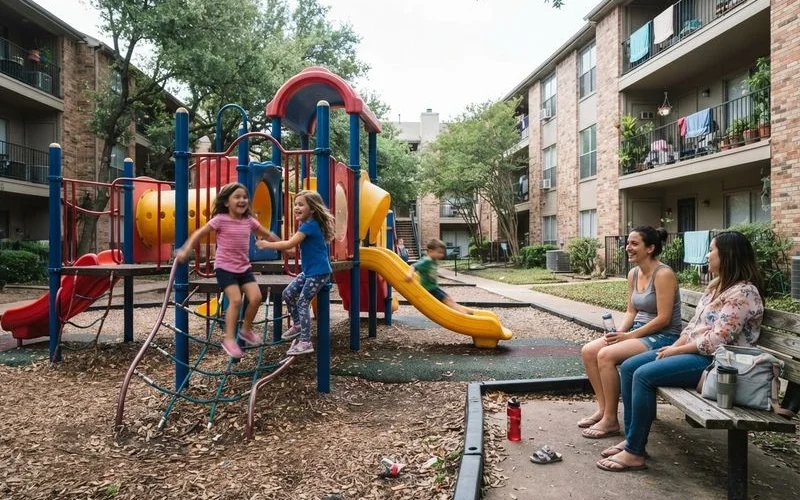
| Family amenities | Playground, splash pad, or other kid-oriented common space |
School boundaries are more specific than they look
This is where families most often get tripped up: school assignment is tied to a specific address, not a general neighborhood or zip code, and district boundary lines can run through areas in ways that aren’t obvious without checking. Before you sign, confirm the exact assigned school for the specific unit’s address directly with the school district, not just a general sense of “this area is zoned for a good school.”
Safety details worth a closer look
A few things matter more with kids in the unit than they would otherwise: whether windows above the ground floor have safety guards or limiters, how balcony railings are spaced and how high they run, and whether a pool area has proper fencing and a self-latching gate. None of these are guaranteed even at family-friendly-marketed communities, so ask and look directly rather than assuming.
Noise and floor level tradeoffs
An upper floor generally means less street noise and foot traffic outside your door, but it also means more stairs or elevator trips with strollers, car seats, and groceries. A ground-floor unit trades some of that convenience for potentially more noise from outside and less privacy from passersby. Neither is universally better; it comes down to your specific routine and how many trips up and down you’re realistically making each day.
Questions worth asking directly
- What’s the specific occupancy policy for a unit this size, for my household?
- What school is this exact address assigned to, confirmed with the district rather than a general area description?
- Are there safety features like window guards or pool fencing, and can I see them on the tour?
- Is there a playground or other family-oriented common space, and how well is it maintained?
See how we evaluate community amenities and resident feedback in our methodology, and start from the homepage to compare current family-friendly options across Greater Dallas.
FAQ
- Can a landlord refuse to rent to me because I have kids?
- No. Federal fair housing law protects familial status, meaning a landlord generally cannot deny an application or set different terms because you have children, with a narrow exception for legally qualifying senior housing communities that are 55 and older or 62 and older.
- How do occupancy limits work?
- Properties commonly apply a guideline of two people per bedroom, sometimes plus one, though the exact standard varies by property and local code. Ask directly how a specific unit's bedroom count and layout would work for your household size before you commit to it.
- How do I check school district boundaries before signing?
- School assignment is based on the specific address, not just the general neighborhood, and boundaries can cut through areas in ways that aren't obvious from a map. Confirm the exact assigned school for a specific unit's address directly with the school district before signing, not after.
- What apartment features matter most for families with young kids?
- Beyond bedroom count, look at window and balcony safety, ground-floor versus upper-floor tradeoffs for stroller and carrier logistics, noise transfer from neighboring units, and whether the community has a playground or other kid-friendly common space.